In this blog, Matt Smart, one of our Lead Scientists, discusses the formation of the ReCell consortium to identify a universal approach to demonstrate the purity of PSC-derived cell therapy products.
1. Please provide an overview of the project presented in this poster
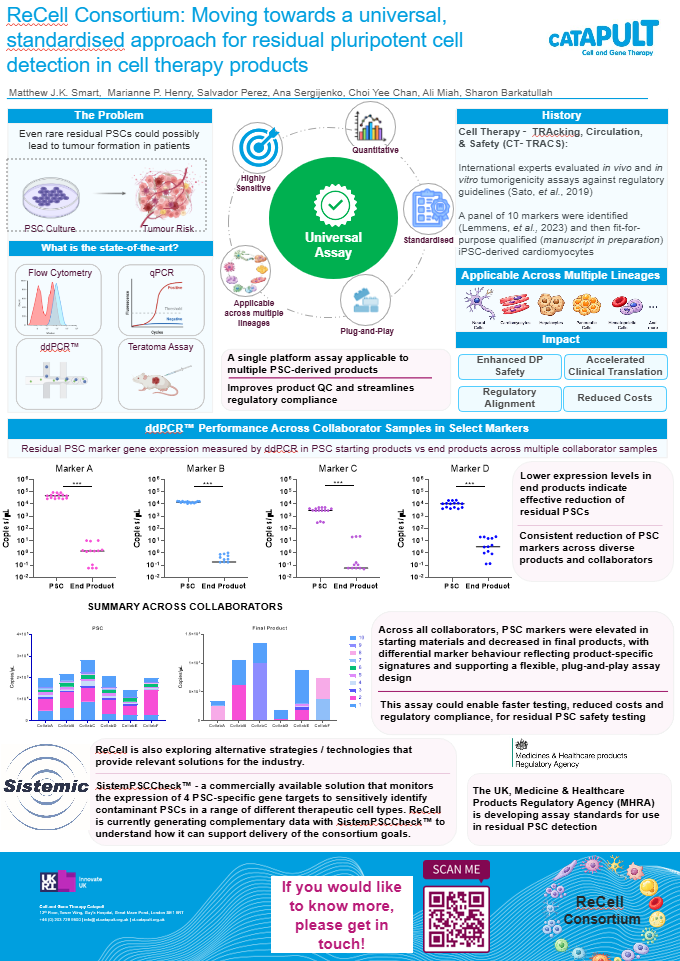
Pluripotent stem cell (PSC)-derived therapies have the potential to cure many diseases; this potential originates from the fact that almost any cell-type can be made from PSCs and used to replace/repair unhealthy or damaged tissue.
PSCs also have an amazing property in that they can continue to divide and produce copies of themselves. This means we can grow vast quantities of them to make all the therapies we might need, but there is another cell type that also has this property – cancer cells. If not all PSCs successfully differentiate into the intended therapeutic cell type, there is a worry that these contaminant cells, known as residual cells, could behave like cancer when we transplant them into patients.
Therefore, it is vital we ensure these residual PSCs are not present in our therapies and can use tests that reliably tell us whether our therapies are appropriately pure. To help us solve this shared industry challenge, and identify universal approaches to demonstrate the purity of PSC-derived cell therapy products, we established ReCell, a 13-partner consortium bringing together regulators, therapy developers, contract development and manufacturing organisations (CDMOs), and a contract research organisation (CRO). Through this consortium, we hope to drive the industry towards standardised testing solutions by working together – something that would not be possible without platforms like ReCell.
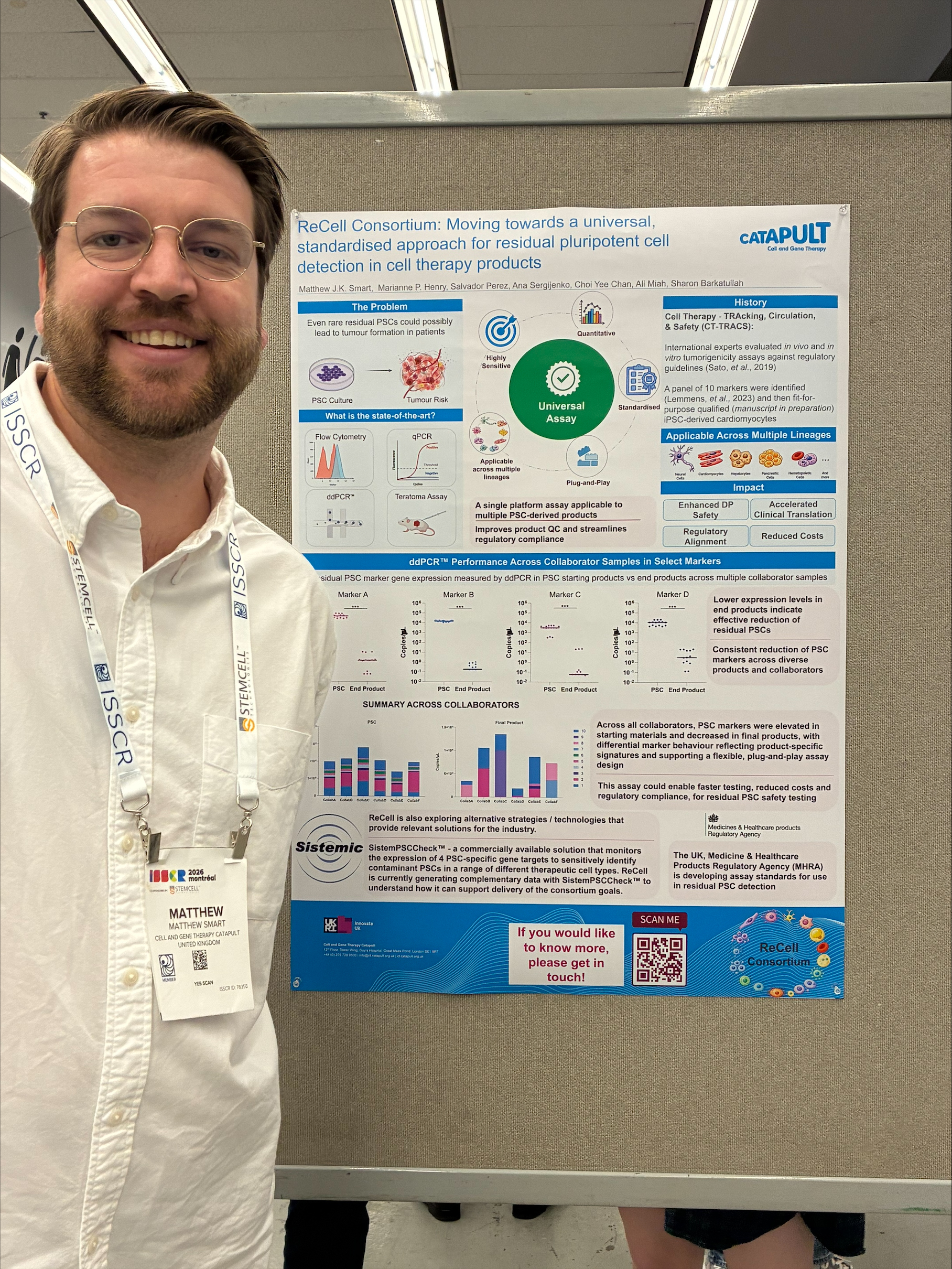
2. Please describe your role and how you are involved in the ReCell consortium?
I’m the project lead of the consortium. My role is to work with each of the different partners to make sure we’re delivering valuable data about their products.
I’m also responsible for consolidating our learnings and helping to shape the conversations we’re having with the wider industry about this problem, highlighting why it’s so important that we have standardised tests to ensure the safety of cell therapy products.
3. What did you find most rewarding about the development of this universal assay for the detection of residual PSCs?
Leading this project has been a great opportunity to work with a variety of interesting companies delivering these exciting therapies to patients. It’s also been really rewarding to work collaboratively with industry in a way that can benefit everyone and have significant impacts for the wider field.
These types of challenges require a critical mass to deliver the most effective solutions, and CGT Catapult can help to provide a forum through which this level of collaboration can take place.
4. What challenges did you experience and how did you overcome these?
At times it can be challenging to coordinate across each of our collaborators, who all work within their own timelines and have their own competing priorities. But that’s where CGT Catapult’s unique position in the industry is really valuable – we can provide the necessary flexibility and agility to respond to individual collaborator needs, while maintaining clear delivery of the broader consortium objectives.
5. How do you plan to build on the success of this consortium?
We plan to continue to grow the dataset by testing more cell lines and more products, in pursuit of a universal assay solution. Looking ahead, we would like to understand how sensitive different testing strategies are, which will help to inform the best way forward.
The great thing about bringing together so many different partners through this consortium is that it can also provide a robust platform to address other key industry needs. It will be exciting to continue to explore what these are and how CGT Catapult can help to solve them.