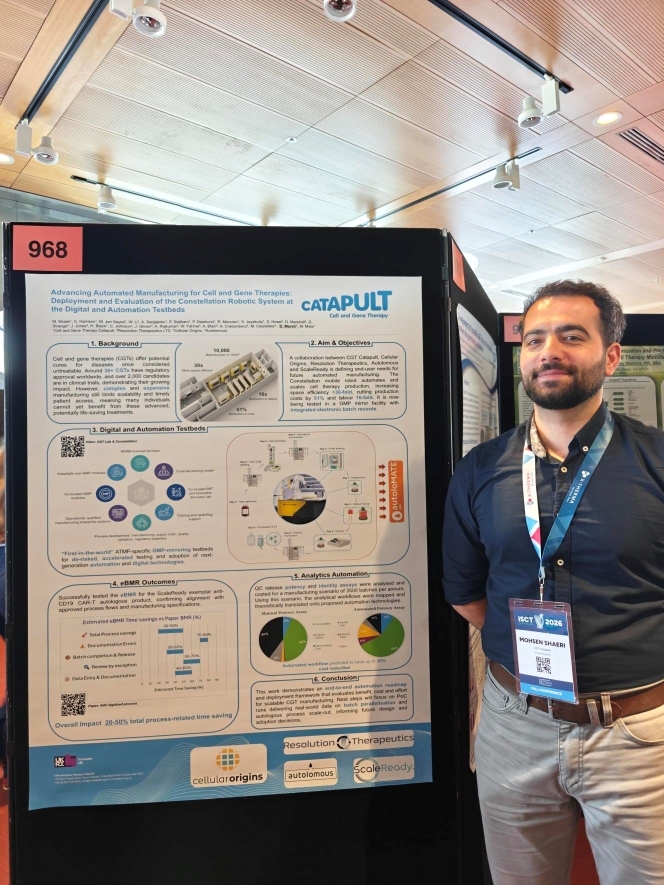
In this interview, Mohsen Shaeri, Associate Lead Scientist at the Cell and Gene Therapy Catapult (CGT Catapult), highlights one of our research projects involving the development of an end-to-end automation roadmap and deployment framework that evaluates benefit, cost and effort for scalable CGT manufacturing.
1. Please provide an overview of the project presented in this poster
This poster highlights an Innovate UK-funded collaborative project involving; CGT Catapult, Cellular Origins, Resolution Therapeutics, Autolomous and ScaleReady. The core aim of this project is to embed robotic automation deeper into the advanced therapy manufacturing space, with the intention of demonstrating more cost-effective, scalable manufacturing to increase throughput, improve consistency, and ultimately help enable broader patient access to these therapies.
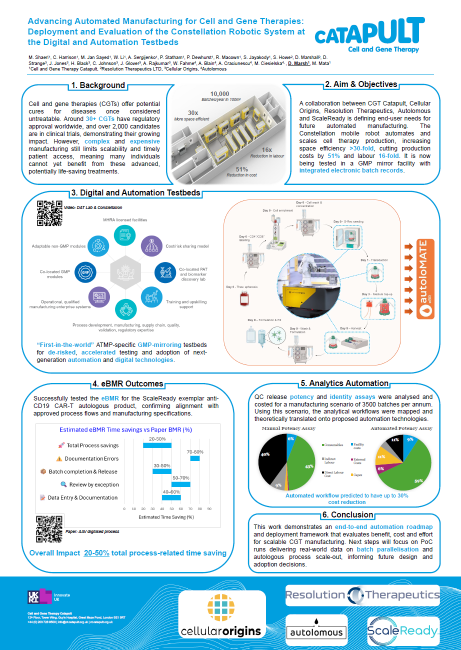
A key focus of the collaboration is assessing how automated robotic systems could support the scale-up of cell therapy manufacturing from clinical to commercial stages. By integrating Cellular Origins’ ConstellationTM robotic platform - featuring automated handling and closed-system operations - with ScaleReady’s established cell therapy manufacturing platform, this project aims to reduce manual intervention, enhance process consistency, and enable more scalable, cost-efficient manufacturing workflows.
In parallel, Autolomous has partnered with CGT Catapult to integrate critical manufacturing systems into an electronic batch manufacturing record (eBMR) within its AutoloMATE platform, helping to digitise and streamline operations across the manufacturing lifecycle.
CGT Catapult will also work with Resolution Therapeutics to understand the steps in Resolution’s own manufacturing process where use of a Constellation system could potentially impact Chemistry, Manufacturing and Controls (CMC) data requirements, helping to ensure that automation is aligned with regulatory expectations.
2. Please describe your role in integrating the robotic system into the Digital and Automation Testbeds.
Initially, a significant part of my role involved learning how the robotic platform (ConstellationTM) works, which involved attending specialist training at Cellular Origins' facility and gaining hands-on familiarity with the platform.
I was also involved in reviewing the user requirement specifications (URS) and functional design specifications (FDS) for the robotic platform, ensuring they reflected CGT Catapult's process and closely aligned with GMP requirements. Working within our Stevenage Manufacturing Innovation Centre (MIC), I contributed to developing quality documentation to ensure safe and controlled ways of working within the testbed, which required close collaboration with the MIC’s operations team given the GMP-mirroring nature of the facility.
3. How would you describe your experience seeing the system operating in a GMP-mirroring environment for the first time?
Seeing the system operate within the Digital and Automation Testbed was a great demonstration of what these facilities are designed for. The testbeds provide a space where new automation and digital technologies can be evaluated in conditions that closely reflect real manufacturing settings, helping teams understand how these tools might perform in practice.
As the facility regularly hosts visitors from industry, academia and clinical organisations, it has also become a valuable platform for demonstrating how emerging technologies could support the future scale-up of advanced therapy manufacturing. Alongside the automation elements, an important part of the work is exploring how these systems integrate with digital infrastructure, such as electronic batch record platforms. Bringing automation and digital systems together in this kind of sandbox environment is an important step towards more connected and scalable manufacturing approaches.
Learn more about the Digital and Automation Testbeds
4. What were the biggest challenges you experienced and how did you overcome these?
One of the biggest challenges was coordinating across multiple organisations, each bringing different expertise, priorities and ways of working. Close collaboration was particularly important when developing documentation such as the URS and FDS, which required several rounds of input and refinement between each of the project partners.
Working within a GMP-mirroring environment introduced additional compliance requirements, as every procedure needed to align with strict site standards, ensuring adherence to defined quality, documentation, and regulatory expectations. Regular communication, structured review cycles and bringing the right technical experts together at key stages helped maintain alignment across the teams. This collaborative approach was essential to progressing the work and keeping the project moving forward.
5. What did you learn from collaborating with multiple partners on this project?
Working across multiple organisations with different areas of expertise, including robotics, cell therapy manufacturing and clinical development, really highlighted the importance of aligning on expectations. Working across multiple organisations spanning robotics, cell therapy manufacturing and clinical development underscored the importance of strong multidisciplinary alignment and collaboration, ensuring shared expectations and coordinated objectives. Each partner brought a different perspective, which helped shape the project and strengthen the overall approach.
One of the key takeaways for me was the value of taking the time to understand what each partner is aiming to achieve, as well as the wider goals of the project. When everyone has visibility of the bigger picture, collaboration becomes much more effective and it’s easier to move the work forward together.
6. How do you plan to build on the success of this project, and what are the next steps?
The immediate next step is completing the CAR-T proof-of-concept runs and really interrogating the data, understanding where the automated process performs comparably to manual and where there are still gaps.
The overall aim is to develop a robust, evidence-based case demonstrating to the broader cell and gene therapy industry that automation is not only operationally viable, but can significantly improve process consistency, scalability, and, ultimately, patient access.
We provide advanced automation capabilities and infrastructure to enable you to evaluate and implement automation solutions, scale high-quality ATMP manufacturing processes and meet real-world patient needs. Contact us to learn more.