In this interview, Ruben Esse, Associate Senior Scientist at the Cell and Gene Therapy Catapult (CGT Catapult), highlights one of our research projects investigating recombinant Adeno-Associated Virus (rAAV) production dynamics through multi-omics profiling of HEK293 clones.
1. Please provide an overview of the project presented in this poster
rAAV vectors are currently utilised in the production of gene therapies, yet current manufacturing processes remain inefficient, with yields often falling short of what is needed for cost-effective large-scale supply. This represents a major bottleneck in the field, where low yields, batch-to-batch variability, and challenges in product quality – often with a high proportion of empty capsids – collectively drive-up production costs and ultimately limit patient access to these transformative treatments.
This poster highlights a project designed to tackle these challenges by generating the biological insights needed to engineer improved producer cell lines. Through a multi-omics approach, we sought to uncover the molecular mechanisms underpinning rAAV production, with the goal of identifying targets that can be leveraged to enhance both cell-specific productivity and volumetric productivity.
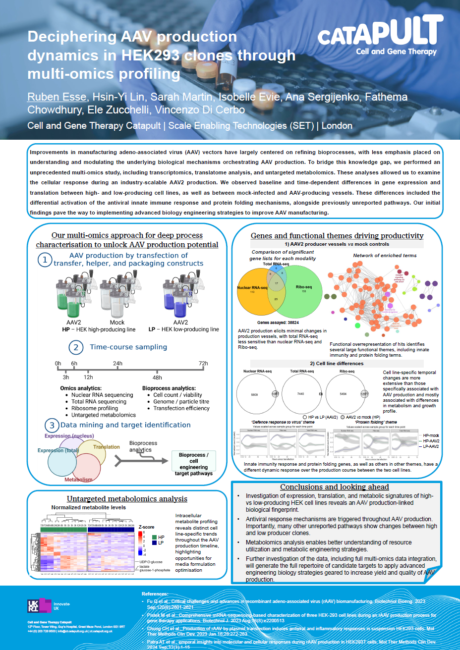
While the industry has focused on improving process parameters, targeted optimisation of cellular mechanisms driving productivity remains resource and cost-intensive. We sought to fill this gap by performing a comprehensive analysis at the levels of gene expression (transcriptomics), protein synthesis (translatomics), and metabolism (metabolomics).
By profiling both high- and low-producing HEK293 clones over the course of the production cycle, we aimed to uncover the molecular pathways involved in rAAV production, identify features that distinguish high-producing cells, and ultimately generate insights to guide next-generation cell line engineering and media optimisation strategies.
2. Please describe your role and how you were involved in this project
This project was truly a team effort. I worked closely with colleagues across different disciplines, contributing to both the experimental and analytical aspects of the study.
While the culturing of HEK293 cells and execution of the rAAV2 production process was led by our bioprocessing scientists, I led the collection of samples across multiple time points during the production timeline. This time-course sampling was critical for enabling the dynamic profiling of cellular states throughout the process.
Together with our analytical team, I processed these samples for downstream multi-omics analyses, ensuring quality and consistency across different modalities. On the data side, I led much of the analysis – applying statistical models, conducting comparative and time-series analyses, and interpreting the results in the context of rAAV productivity and cellular biology.
This combined effort allowed us to draw meaningful insights from complex datasets and contribute to a deeper understanding of the biology of rAAV producing cells.
3. What insights did you find the most interesting when conducting multi-omics profiling of HEK293 clones?
One of the most striking and exciting aspects of this project was the extent of the cellular changes observed during rAAV2 production and how differently these changes unfolded depending on the HEK293 clone used.
The data revealed that rAAV2 production triggers significant activation of innate immune and protein-folding pathways, as well as previously under-explored pathways involved in cellular stress responses, metabolism, and growth regulation. The fact that high- and low-producing cell lines responded so differently, even under identical production conditions, underscores the importance of tailoring manufacturing strategies to the biology of the specific clone.
This study strongly supports the idea that rAAV production is highly context-dependent, and we can use that knowledge to fine-tune systems for improved yields going forward.
4. What challenges did you experience and how did you overcome these?
Executing a study of this complexity required careful coordination. The experimental workflow involved multiple operators and a detailed, time-sensitive sample collection plan spanning several days. To ensure consistency, we developed a robust protocol for sample collection and processing, aligning on responsibilities and contingencies in advance.
The data analysis presented its own challenges. Designing statistical models that could accommodate multiple cell lines, mock controls, and time points was not straightforward. We invested time in researching the literature, and consulting in-house experts, to find the best approaches for clustering, time-series modelling, and multi-group comparisons.
In the end, it was a combination of good planning, team communication, and iterative testing of analysis strategies that allowed us to overcome these obstacles and produce robust and reproducible results.
5. How do you plan to build on the success of this project in the future?
The most impactful outcomes of this project are the new biological insights we have into the rAAV production process.
We’ve now identified key pathways that are engaged during vector production, and, importantly, how those responses differ between high- and low-producing clones.
This knowledge can now be applied in several ways. First, it provides candidate targets for cell line engineering to enhance productivity, for example, modulating stress or protein folding pathways. Second, by integrating metabolomics data, we can better understand nutrient consumption and waste profiles, enabling more rational media design that supports sustained growth and efficient protein synthesis.
Finally, we plan to take this work further by applying advanced machine learning approaches to integrate the different omics layers more effectively. This will help us identify predictive signatures and guide future development of scalable, optimised rAAV manufacturing systems.
Contact us if you are looking to enhance the efficiency of your AAV production process