In this blog, laboratory technician Ted Mason, discusses how we have streamlined our adeno-associated virus (AAV) analytical capabilities through the integration of an automated assay for DNA impurity detection.
1. Please provide an overview of the project presented in this poster
Many gene therapies use viral vectors for the targeted delivery of therapeutic genes to patients. However, during the viral vector production process, many other substances can be produced, considered ‘impurities’, which require purification to remove as they can be harmful to patients.
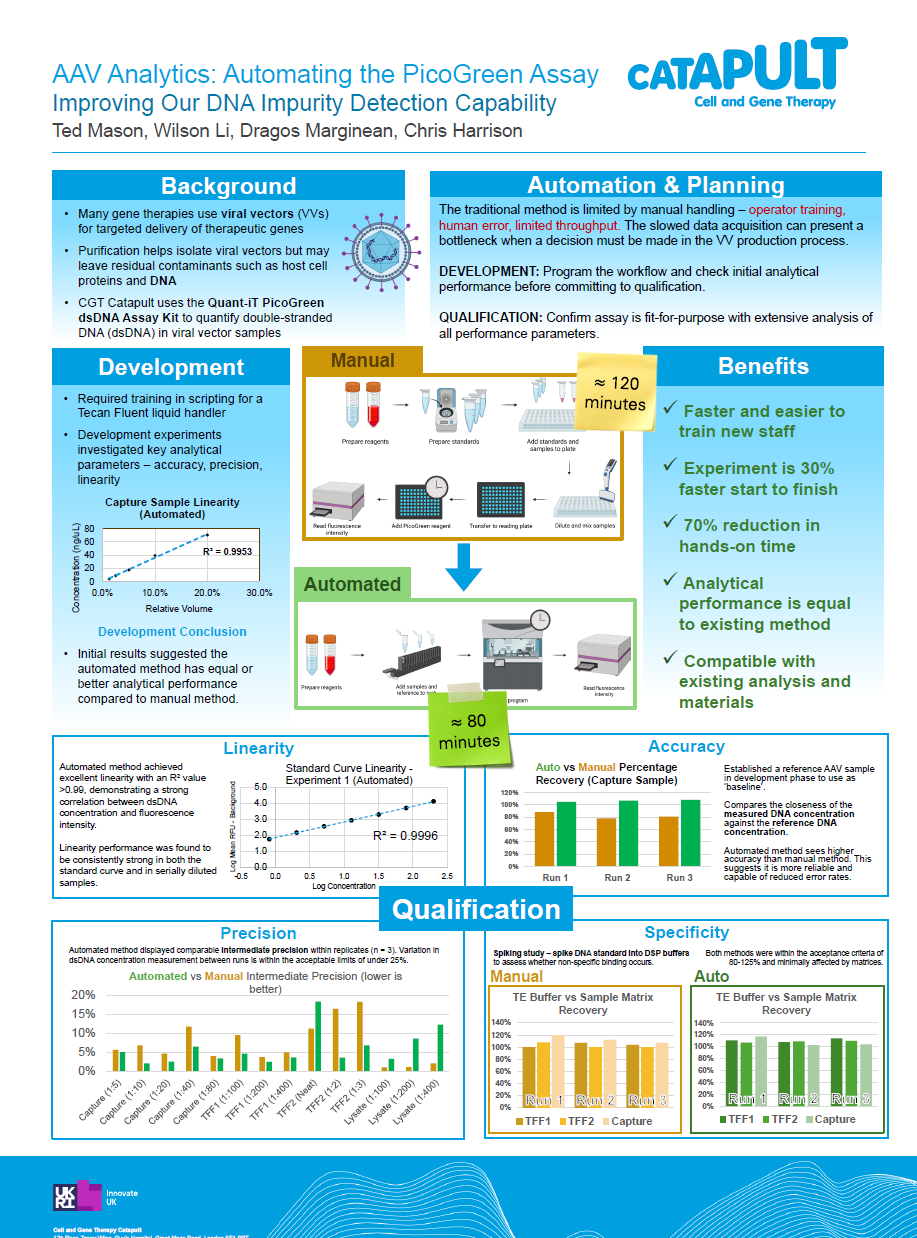
When we produce AAV vectors we need to analyse the samples for the presence of these impurities, such as double-stranded DNA (dsDNA). Historically, we have used the PicoGreen detection method, which is a highly sensitive test that uses a unique fluorescent dye to measure how much dsDNA is in a sample, lighting up brighter as more dsDNA is present. This method is very hands-on for a lab technician and can be time consuming and prone to human error.
This project focuses on our successful automation of the PicoGreen method. Through integration of our existing liquid handling device into our workflow, much of the process can now be completed robotically. Automation offers significant benefits, improving the speed and reducing the error rates of this process, as well as enabling the operator to perform other tasks while the liquid handler performs the assay.
2. Please describe how this project has supported your skills development through your apprenticeship at CGT Catapult
As the final piece of work in my apprenticeship, which I completed in 2025, the project provided me with a significant level of autonomy and growth. Supported with guidance from our expert project team, I was able to lead on this exciting project, developing the proposal and coordinating team meetings, creating experimental plans and performing the work myself in the lab, and finally writing the reports and presenting results.
By design, this project was structured so that I was responsible for completing over 90% of the work myself. Prior to this, I had limited experience in many of these experimental techniques and in project leadership, but support from my peers allowed me to build my skillset and learn from feedback as the work went on. Through this activity, I have gained a variety of new skills, particularly in critical thinking and the fundamentals of project management and experimental design.
3. What have been the benefits from transitioning from a manual to automated impurity detection process?
We have calculated that the automated method cuts down the overall length of each experiment by 30%, allowing data to be returned to project teams more rapidly for analysis. With 70% of the steps being completed by the pipetting robot, technicians can also work on other projects in the meantime.
In 2025, our team collectively completed 40 PicoGreen experiments, amounting to around 80 hours of work in the lab. By using the liquid handler this number can be reduced to 50 hours per year, with 23 being spent hands-off while the automated method works by itself. We calculate that in a full year this can save nine full working days which can be redirected to other functions of the organisation.
Additionally, the automated method has been proven to perform as effectively as the manual method and it allows faster training of operators, given that there are now fewer manually performed steps.
4. What challenges did you experience integrating this assay and how did you overcome these?
Initially, learning to program the liquid handling device was a daunting challenge. With little experience in this area, it was challenging to know how to structure the early lab work and figure out how long it might take using the automated method.
During the project planning phase, extra time was built in for me to ensure I had adequate time to complete my learning and familiarise myself with the robot. This flexibility, combined with tutoring from our in-house automation experts, enabled me to progress the project quickly from the learning phase to the development phase and reach early milestones on time.
5. How do you plan to build on the success of this method in the future?
We are currently assessing whether this newly developed method can be applied to the testing of lentiviral samples for dsDNA impurities. This is a different type of viral vector to AAV that we are also working with regularly. If it is effective, projects producing lentiviral samples will also be able to benefit from the increased efficiency the automated method can provide.
Additionally, there are plans to leverage the experience gained in this project to create training materials for those in the industry looking to learn about and adopt automated platforms. As a critical part of the future of the cell and gene therapy space, automation needs to become integrated more widely across the industry. The success of this apprenticeship project in automating a commonly used assay demonstrates the broader potential these technologies can have in this space.
If you're looking for support to enhance your current AAV development process, contact us.