In this interview, Charlotte Lee-Reeves, Associate Senior Scientist at the Cell and Gene Therapy Catapult (CGT Catapult), discusses one of our research projects using multi-omics profiling to enhance our understanding of an iPSC natural killer cell therapy production process.
1. Please provide an overview of the project presented in this poster
Building on a recent collaboration to scale an iPSC-derived natural killer (iNK) cell process for manufacturing, this poster presents the follow-on data analysis project from this work.
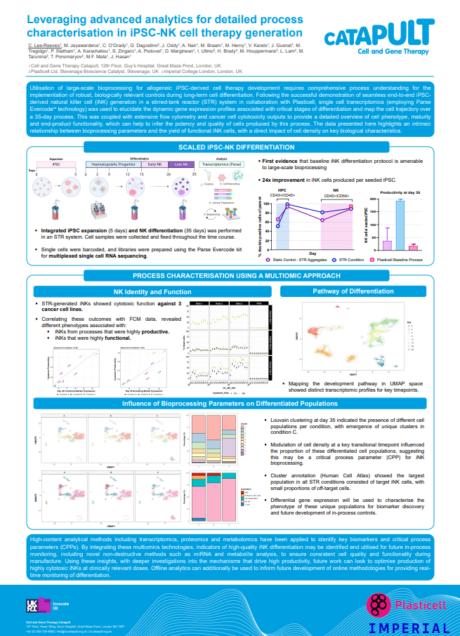
This poster focuses on our work using single cell RNA sequencing (scRNAseq) to identify the target iNK cell population and its trajectory over time. We investigated the influence of different cell density conditions on the composition of the final product and proportion of on- and off-target cells.
2. Please describe your role and how you were involved in this project
In the initial phase of the project, I was part of the laboratory team directly involved in developing the scaled-up manufacturing process. I served as the subject matter expert in iPSC biology and differentiation, working closely with analytical scientists and bioprocess engineers in our multidisciplinary team.
After completing the experimental phase, I transitioned into an analytical role, leading the single-cell transcriptomics) study. We interpreted this data in the context of the overall process, integrating it with functional assays and a variety of -omics datasets in collaboration with our data science team.
3. What did you find most interesting about working on this project?
One of the most interesting aspects of this project was uncovering correlations between cellular characteristics and functional performance. Specifically, identifying links between levels of gene and protein expression of the iNK cells and their ability to kill different types of cancer cell lines.
For example, with the scRNAseq and advanced flow cytometry panels, we were able to identify key markers associated with potency indicating cells. These findings not only deepened our understanding of the underlying biology but helped to put the work we do in perspective and offered important context for the potential translational impact.
Bridging the gap between the process development that we do in the lab, and the potential therapeutic function, reinforces the relevance of our work and makes it a very exciting time to be involved in these kinds of therapies.
Learn more about our expertise in the development of cell therapies.
4. What challenges did you experience and how did you overcome these?
Omics datasets are inherently large and highly complex, making it difficult to extract key insights from individual analyses alone. By working closely with our data science experts, we were able to explore and apply multiple methods of data integration.
This allowed us to combine diverse datasets, including gene expression, protein levels, cell surface markers, metabolites, microRNAs, and cytotoxicity data, into a unified, meaningful analysis.
One of the key challenges we faced was the variety in the structure of the data output from each analytical technique. Significant time was dedicated to harmonising the results into a compatible format, so we could more easily analyse and make links between different aspects of the cell biology. We recognised the need to have robust digital infrastructure to achieve these ambitious aims, which has helped to inform our process for capturing data as it is generated.
We have now gained a stronger appreciation for strategic sample collection, ensuring future studies are designed with the end-goal and data integration in mind from the outset. As a result of this experience, we are now much better equipped to plan and execute these large multi-omics studies.
5. How do you plan to build on the success of this project in the future?
This project significantly enhanced our expertise in scalable differentiation and provided us with a robust framework for deep process characterisation using large-scale datasets.
Importantly, we are now better equipped to identify which outputs are most informative and relevant to both product yield and potency.
Moving forward, we will apply this knowledge to future projects by designing more targeted and efficient differentiation processes, as well as more strategic analytical approaches. This will enable predictive process development and ultimately accelerate the path to manufacturing readiness through deeper biological and functional insight.
Contact us if you are looking to improve your cell therapy development process