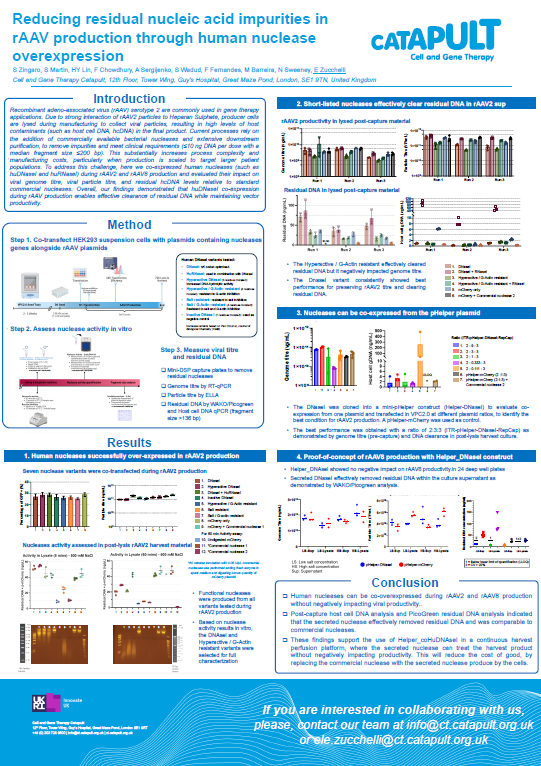
In this blog, Ele Zuchelli, Associate Lead Scientist at the CGT Catapult, explores how we have established a method to reduce residual nucleic acid impurities in Recombinant adeno-associated virus (rAAV) production through overexpression of human nuclease.
1. Please provide an overview of the project presented in this poster
rAAV serotype 2 (rAAV2) is commonly used to deliver genetic material in gene therapy. However, producing rAAV2 requires the cells that make the viral particle to be broken open so the viral particles can be released. This step also releases unwanted material from the cells, including proteins and DNA, which must then be removed during purification to meet regulatory requirements.
Currently, manufacturers often use expensive recombinant bacterial enzymes, together with several purification steps, to remove DNA impurities that arise during viral vector production. These steps increase manufacturing costs and can ultimately make gene therapy treatments more expensive, especially when production needs to be scaled up for larger patient groups.
In this project, we wanted to test whether the same cells used to produce viral vectors could also produce recombinant human enzymes to remove the DNA impurities at the same time of rAAV2 production. This could reduce manufacturing costs and simplifying downstream purification. In the study, we compared different enzyme variants expressed during rAAV2 production and selected the best candidate, or candidates, based on their effect on viral vector yield and their ability to remove cell-derived DNA impurities.
2. Please describe your role and how you were involved in this project
As Associate Lead Scientist, I worked closely with the Project Lead from the start to help ensure the successful delivery of the project. My role included reviewing the existing literature, planning experiments, reviewing results, and, most importantly, coordinating and supporting the team assigned to the work. In our work, the team is essential, and I was extremely fortunate to coordinate a small group of brilliant scientists who worked hard to complete the project.
3. What challenges did you experience and how did you overcome these?
Every time we tried to reduce the cell-derived DNA impurities released during a manufacturing process, we needed to carefully balance this with the effect on viral vector yield and overall process efficiency.
Some of the mutants we tested were very effective at removing impurities but reduced product yield, whereas others preserved yield but were less effective at impurity removal. The efficiency of the mutants can also vary depending on the salt concentration and pH of the system. To identify the most suitable option for our production conditions, we screened several combinations of mutants and different experimental conditions.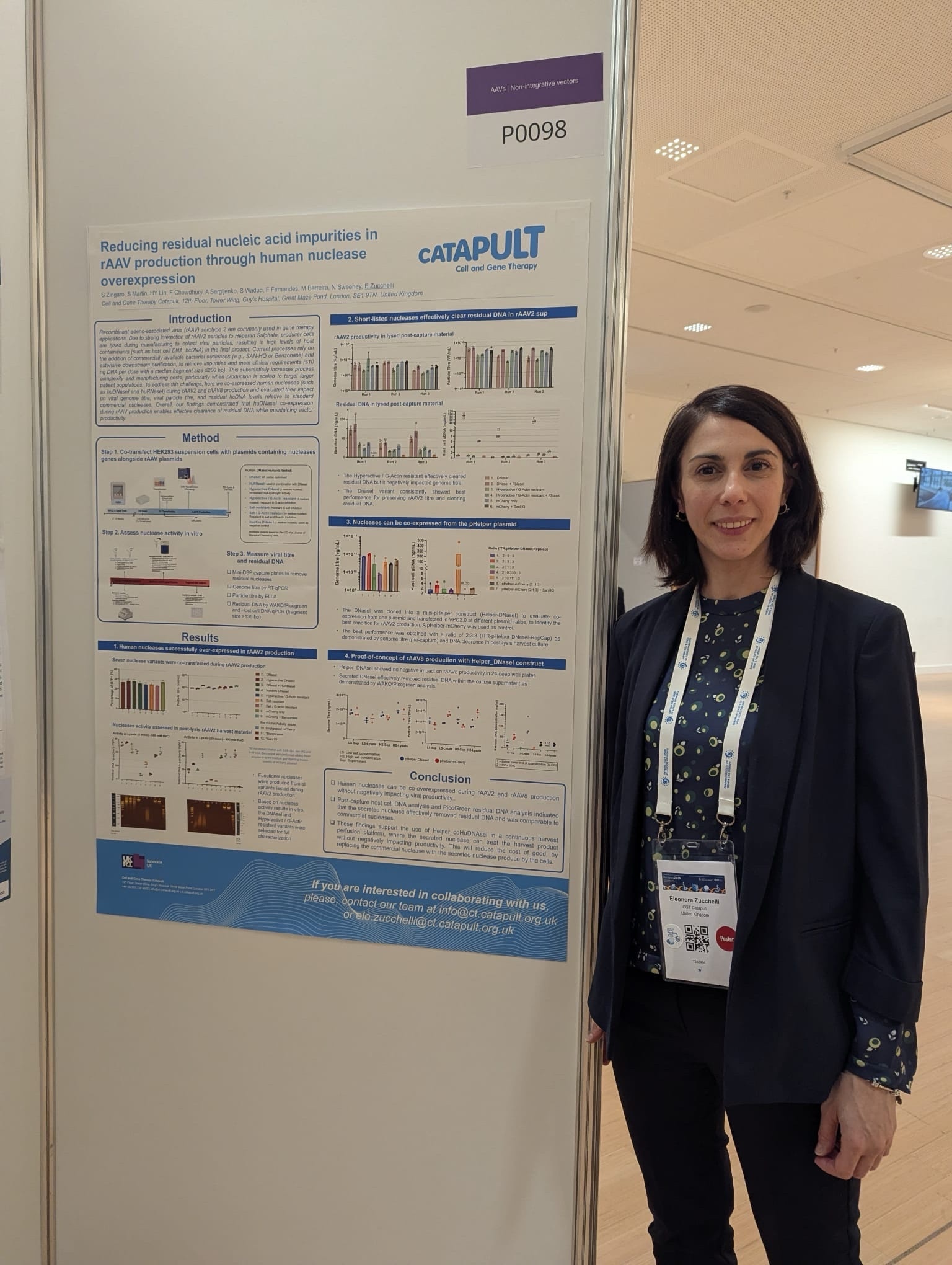
4. How do you think the development of this technique will benefit the broader gene therapy community?
The AAV gene therapy industry continues to face significant challenges around high manufacturing costs, process complexity, scalability and effective removal of process-related impurities, all of which can limit commercial viability and patient access.
This project developed a more cost-effective approach for removing cell-derived DNA during rAAV production without compromising vector yield. By reducing reliance on expensive recombinant nucleases and enabling earlier DNA clearance, this approach could reduce the burden on downstream purification, simplify processing, improve process robustness and lower cost of goods.
Importantly, more effective integration of DNA-removal strategies within upstream processing could also facilitate process intensification and the future development of more integrated and continuous AAV manufacturing processes. Overall, the project demonstrated an approach with the potential to make AAV manufacturing more scalable, efficient and economically sustainable, ultimately supporting broader access to gene therapies.
5. How do you plan to build on the success of this project in the future?
We are currently preparing the project results for publication in a peer-reviewed journal to share the findings with the wider gene therapy community and support broader adoption of the approach.
Building on the success of the project, we plan to assess the transferability of the DNA-removal method to other viral vector manufacturing platforms, including lentiviral vectors, to determine its potential applicability beyond rAAV.
We also aim to evaluate its integration into our proprietary continuous AAV manufacturing platform, working across our upstream and downstream process development teams. This will help determine whether the approach can support more integrated and intensified manufacturing, reduce downstream purification burden, and ultimately improve the scalability and cost-effectiveness of viral vector production.
Contact us to learn how we can improve the efficiency of your process.